Explore Falaknuma Palace Hyderabad Nizam Era Luxury

Step Into 1893 Splendor at Hyderabad’s Sky-High Falaknuma Palace
Perched majestically 2,000 feet above Hyderabad, Falaknuma Palace earns its Persian name meaning “Mirror of the Sky.” Built in 1893, this sprawling 32-acre masterpiece reflects the unmatched opulence of the Nizam era. Five times larger than India’s Parliament, it blends European grandeur with Indian royalty, whispering tales of lavish banquets, rare artifacts, and royal secrets in every marble corridor.
Once nearly bankrupting its creator, the palace became the cherished home of the sixth Nizam. Today, restored as a Taj luxury hotel, Falaknuma Palace Hyderabad invites visitors to live like royalty amid Venetian chandeliers, hand-painted ceilings, and the world’s longest dining table.
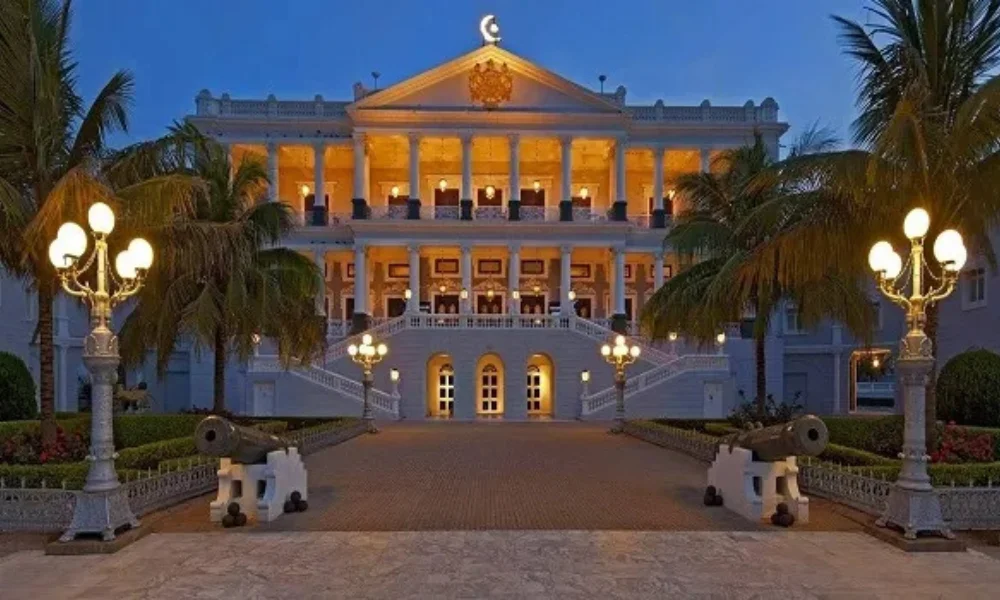
A Scorpion-Shaped Marvel Born from Ambition
Nawab Sir Viqar-ul-Umra, Prime Minister of Hyderabad State, dreamed big. Inspired by Palladian and Italian Renaissance styles during European travels, he commissioned Falaknuma Palace in 1884. Construction spanned nine years, costing Rs 4 lakh an astronomical sum that nearly ruined him financially.
The palace’s scorpion silhouette from above symbolized protection and power in Islamic architecture. Italian marble, English tiles, and French crystal arrived by ship, assembled by 400 craftsmen. When completed in 1893, its 220 lavish rooms and 22 halls left even seasoned travelers speechless.
The turning point came in 1897. Sixth Nizam Mir Mahboob Ali Khan visited as a guest and fell in love instantly. He purchased the palace for Rs 20 lakh, gifting Viqar-ul-Umra the title “Duke of the Realm.” From then, Falaknuma became the Nizam’s private retreat, hosting viceroys, kings, and presidents.
Abandoned post-independence, the palace decayed until Taj Hotels restored it over ten years, reopening in 2010. The $35 million project preserved original frescoes, furniture, and even the Nizam’s personal artifacts, earning UNESCO Asia-Pacific heritage awards.
The Grand Staircase: Gateway to Royal Splendor
Entering Falaknuma feels cinematic. A horse-drawn carriage ascends the winding driveway, revealing the palace glowing against the sky. The marble grand staircase splits symmetrically, flanked by life-sized statues of Greek gods and Rajasthani warriors.
Overhead, a 40-foot Venetian chandelier with 400 bulbs sparkles like diamonds. Hand-painted ceilings depict Mughal gardens and European landscapes. The balustrade features intricate jaali work, allowing cool breezes to flow through while maintaining privacy.
Each step echoes with history Queen Mary climbed these in 1911, followed by President Rajendra Prasad in 1950s. The staircase leads to the upper durbar hall, where gold-embossed ceilings and silk tapestries create an ethereal atmosphere.
World’s Longest Dining Table: Feasts Fit for 101 Royals
The 101-seater dining hall remains Falaknuma’s crown jewel. The world’s largest dining table stretches 80 feet, crafted from seven teak segments polished to mirror shine. Above, 24 Belgian crystal chandeliers cast rainbow prisms across gold-rimmed Rosenthal china.
Acoustics are legendary a whisper at one end travels crystal clear to the other. The Nizam used oil paintings lining walls as his menu, pointing to desired dishes. Silver thalis served Hyderabadi biryani, Persian kebabs, and English roasts simultaneously.
The table once hosted King George V, Russian Grand Duke, and Ethiopian Emperor Haile Selassie. Today, guests enjoy curated Nizami dinners with 40-course menus, including lost recipes like shikampuri kebab and double ka meetha.
Adjacent Gol Bangla houses the royal crockery collection 10,000 pieces of Belgian glassware and gold-plated cutlery. The silver service train, pulled by attendants, delivered food from basement kitchens via hydraulic lifts.
Library of Legends: India’s Finest Private Collection
Modeled after Windsor Castle’s library, Falaknuma’s reading room houses over 6,000 rare volumes. Walnut-paneled walls rise two stories, accessed by spiral staircase. The ceiling features leather-bound motifs of peacocks and lotuses.
First editions include 1801 encyclopedias, Qurans inscribed in gold, and botanical studies commissioned by the Nizam. A handwritten guestbook records visits by Rudyard Kipling and Mark Twain. The original card catalog, carved from rosewood, remains functional.
The Nizam’s personal desk holds his fountain pen collection and ivory paperweights. Climate-controlled cabinets preserve Persian manuscripts and Telugu poetry. Scholars require special permission to access this Nizam library treasure.
Musical Marvels: Rare Pipe Organ and Royal Billiards
Only two manually operated pipe organs exist worldwide Falaknuma owns one. Installed in 1911 by German craftsmen, its 400 pipes produce haunting melodies. The bellows require four men to pump air, creating cathedral-like resonance.
The billiards room features a table identical to Buckingham Palace’s, gifted by Edward VII. Ivory balls and ebony cues remain original. The Nizam played with Indian maharajas and British officers, wagering diamond rings on frames.
A 100-year-old music box plays Beethoven when wound. The palace orchestra once included European violinists and Indian sitar maestros, performing fusion ragas for state banquets.
Bedrooms Fit for Emperors: Nizam’s Private Suites
The Nizam’s bedroom spans 2,000 square feet with a teak four-poster bed draped in Belgian lace. Jade collection includes a 400-carat emerald pendant. The attached bathroom features a marble bathtub carved from single stone.
The Begum’s suite showcases mother-of-pearl inlay and French perfume bottles. A secret passage connected royal chambers for privacy. The hookah room displays 50 antique hookahs with meerschaum bowls.
Guest suites named after historical figures Queen Mary, Prince of Wales retain original furniture. The Princess Esra suite offers panoramic city views through stained-glass windows.
Gardens and Terrace: Where Hyderabad Meets the Heavens
The palace gardens span 32 acres with Andalusian fountains and Mughal charbaghs. Rare orchids bloom alongside frangipani trees. Peacock families roam freely, their calls echoing at dusk.
The circular terrace offers 360-degree views Charminar glitters in distance, airplanes appear toy-like below. Sunset high tea served here includes Nizami chai and osmania biscuits. Night transforms the city into a sea of twinkling lights.
The jade collection terrace displays 400 pieces under moonlight. Astronomy sessions use the original 1910 telescope to spot constellations named in Persian.
Royal Experiences: Living the Nizam Dream
Taj Falaknuma offers palace stays starting at Rs 40,000 per night. Horse carriage welcome, rose petal baths, and personal butlers recreate royal treatment. The Jiva Spa uses gold-infused oils and pearl scrubs from Nizam-era recipes.
Heritage walks reveal hidden passages and original safes holding uncut diamonds. Cooking classes teach lost recipes like haleem-e-Falaknuma. Vintage car rides in 1930s Rolls-Royce Phantom complete the fantasy.
Evening aarti at the palace temple blends Hindu and Muslim traditions. The Nizam’s durbar reenactment features actors in period costumes. Photography tours capture Instagram-worthy moments at golden hour.
Preserving Legacy: Challenges and Triumphs
Restoration required importing Italian marble dust to match original plaster. Termite-damaged wood was replaced with aged teak from Burma. Artisans spent 5,000 hours regilding ceilings with 24-carat gold leaf.
The palace generates revenue through tourism while funding local schools. Solar panels power gardens, reducing carbon footprint. Community programs teach traditional crafts to youth.
Falaknuma stands not just as architecture but as living history. Every restored fresco, every polished banister, carries forward the Nizam’s vision of Hyderabad as India’s cultural jewel.
Visit Falaknuma Palace Hyderabad to witness where earth touches sky, where past embraces present, and where every visitor becomes part of an enduring royal legend. The Mirror of the Sky reflects not just clouds, but the grandeur of a bygone era preserved for generations to come.
Facebook Comments









-
 Explore the upcoming Tamil film Maaman - cast, sto...
 -
 Read the ACE (2025) movie review starring Vijay Se...
 -
 Check out Maaman's 1st day box office collection a...
 -
 Explore tourist family reviews for Maaman movie –...
Popular Posts
Vote / Poll
Recent Posts



Recommended Posts

-
 Discover the best schools in Nagercoil f...
 -
 Discover the top-rated preschools in Nag...
 -
 Explore the best schools in Nagercoil th...

Comment / Reply From