The Official Statutes and Directives of Competitive Table Tennis (Ping Pong)
The Official Statutes and Directives of Competitive Table Tennis (Ping Pong)
Table tennis, frequently referred to as ping pong, is recognized as one of the fastest and most technically challenging sports played around the world. From community recreation centers to elite international arenas, the sport has grown into a highly competitive discipline requiring speed, reflexes, precision, and strategic intelligence. The global structure and governance of competitive table tennis are supervised by the International Table Tennis Federation (ITTF), which establishes and enforces standardized rules to maintain fairness and consistency across all official tournaments.
In recent years, table tennis has gained renewed global attention due to professional leagues, Olympic competition, and the rise of the World Table Tennis tournament series. These developments have increased public interest in understanding how the sport operates at the highest levels. The following report provides a detailed explanation of the official rules, equipment regulations, scoring systems, and global tournaments that define modern competitive table tennis.
Overview of Competitive Table Tennis
Competitive table tennis is played on a rectangular table divided by a net barrier positioned across the center. Players use rackets, often called paddles or bats, to strike a lightweight plastic ball back and forth across the table surface. Matches can be played in singles format, involving one competitor on each side of the table, or in doubles format where two players form a team and alternate shots during play.
The primary objective of the game is to score points by making returns that the opponent cannot legally send back onto the table. Although the concept appears simple, the sport becomes highly demanding due to the speed of the ball and the complex spin techniques applied by professional athletes. At elite levels, players combine physical agility with tactical awareness to dominate rallies and control the rhythm of play.
Official Equipment Standards
Table Specifications
The table used in professional competition must meet precise international measurements. According to official guidelines, the length of the table must be 2.74 meters and the width must measure 1.525 meters. The playing surface must be positioned exactly 76 centimeters above the ground. The surface is typically dark colored with a matte finish in order to minimize reflections that could interfere with visibility during fast rallies.
A white boundary line runs along the edges of the table and divides the playing zones. These lines are crucial for determining whether a shot lands within the legal area of play during competitive matches.
Net Requirements
The net system stretches across the center of the table and divides the two sides of play. The height of the net must be exactly 15.25 centimeters. During official tournaments, the net must remain firmly attached and tightly stretched to ensure consistent ball movement throughout the match.
Ball Specifications
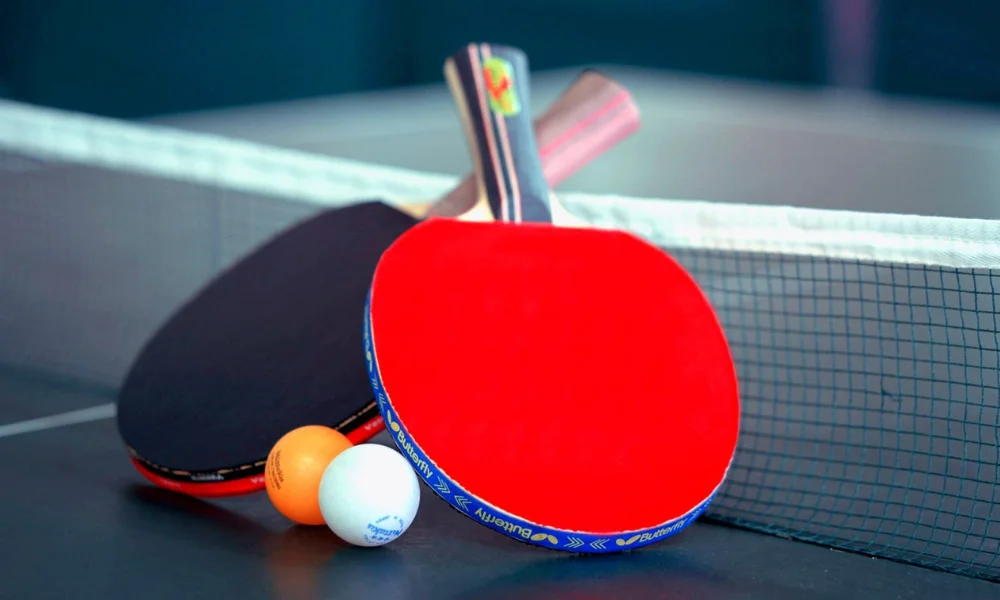
The table tennis ball used in modern competitions is made from lightweight plastic and has a diameter of 40 millimeters. The official weight of the ball is approximately 2.7 grams. It may appear either white or orange depending on the playing environment and lighting conditions.
Quality testing standards also determine the bounce characteristics of the ball. When dropped from a height of 30 centimeters onto a regulation table surface, the ball must rebound approximately 23 centimeters.
Racket Construction
A professional table tennis racket consists of a wooden blade covered with specialized rubber surfaces. Official regulations require that at least 85 percent of the blade material must be natural wood. One side of the racket must be bright red while the other must be black, allowing opponents and officials to identify the rubber type used for each stroke.
Different rubber textures enable players to create various levels of spin, speed, and ball control. Professional athletes often choose equipment configurations tailored to their playing style and strategic approach.
Match Structure and Game Format
Professional table tennis matches follow a structured format designed to maintain fairness and competitive balance. Matches are usually played as the best of five games or best of seven games depending on the tournament stage. Each individual game is played to eleven points, and a competitor must achieve at least a two point advantage in order to win the game.
If the score reaches ten points for both players, the situation becomes known as deuce. At this stage, the game continues until one player secures a two point lead over the opponent. This rule often creates intense final rallies that test both endurance and concentration.
Serving Regulations and Service Rotation
Serving is one of the most strategic elements of competitive table tennis. The ball must rest freely on the open palm of the server before the serve begins. The server must toss the ball vertically at least sixteen centimeters into the air and strike it after it begins to descend. Throughout this motion, the ball must remain visible to the receiving player and the match officials.
During a legal serve, the ball must first bounce on the server's side of the table before crossing the net and landing on the opponent's side. In doubles play, the serve must travel diagonally from the right side of the server's court to the right side of the receiver's court.
Service rotation follows a strict pattern. Each player serves two consecutive points before the serve switches to the opponent. When the score reaches ten points each, players alternate the serve after every single point.
Common Faults and Gameplay Violations
Competitive matches are monitored by umpires and referees who ensure that every rally follows official regulations. Points are awarded when a player commits a violation or fails to return the ball correctly.
Common faults include serving illegally, striking the ball outside the playing surface, touching the table with the free hand, or allowing the ball to bounce twice on the same side of the table. Players also lose points if they touch the net assembly or obstruct the ball before it crosses the table boundary.
Major International Table Tennis Tournaments
Olympic Table Tennis Tournament
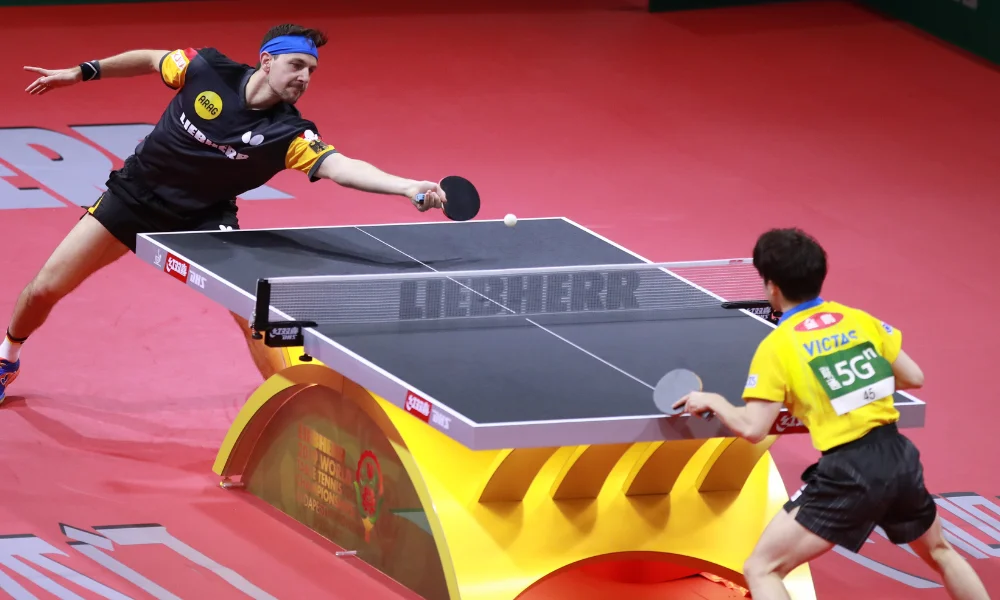
Table tennis officially became part of the Olympic Games in 1988. Since then, the Olympic tournament has become one of the most prestigious events in the sport. Olympic competition includes men's singles, women's singles, and team events where national squads compete for global recognition and medals.
World Table Tennis Championships
The World Table Tennis Championships are among the oldest international competitions in the sport. Organized by the ITTF, these championships feature singles, doubles, mixed doubles, and team competitions. Winning a world title is considered one of the greatest achievements in professional table tennis.
ITTF World Cup
The ITTF World Cup focuses on top ranked individual athletes from around the world. The tournament features a smaller number of participants compared to other competitions, which creates a highly competitive environment where only elite players qualify through ranking positions or continental championship victories.
World Table Tennis Tournament Series
The World Table Tennis tournament series represents the modern professional circuit for the sport. Events such as WTT Contender, WTT Star Contender, WTT Champions, and WTT Finals attract the highest ranked athletes and distribute ranking points that determine global standings. These competitions have helped modernize the sport and increase international viewership.
Continental Championships
In addition to global competitions, regional championships are organized across continents. Events such as the Asian Table Tennis Championships, European Championships, Pan American Championships, and African Championships serve as qualification pathways for world events and provide opportunities for emerging athletes to gain international experience.
Facebook Comments














-
 Explore the upcoming Tamil film Maaman - cast, sto...
 -
 Read the ACE (2025) movie review starring Vijay Se...
 -
 Check out Maaman's 1st day box office collection a...
 -
 Explore tourist family reviews for Maaman movie –...
Popular Posts
Vote / Poll
Recent Posts



Recommended Posts

-
 Discover the best schools in Nagercoil f...
 -
 Discover the top-rated preschools in Nag...
 -
 Explore the best schools in Nagercoil th...

Comment / Reply From