Why the Aravalli Hills Matter to North India

Why the Aravalli Hills Matter to North India
One of the world's oldest mountain systems, the Aravalli Hills have returned to national attention following a recent ruling by the Supreme Court of India. While the judgment may appear technical on the surface, environmental experts and policy analysts warn that it carries far-reaching implications for environmental protection, land-use governance, and climate resilience across large parts of North India. The Aravalli landscape is deeply intertwined with the ecological, climatic, and social stability of the region, making any legal reinterpretation of its status a matter of broad public interest.

Geological Significance of the Aravallis
The Aravalli Range stands apart from all other mountain systems in India due to its immense geological age. Scientists estimate that the range dates back nearly two billion years to the Proterozoic era, making it far older than the Himalayas and even predating the emergence of complex life forms on Earth. Over vast spans of geological time, the Aravallis have survived tectonic shifts, erosion, volcanic activity, and dramatic climatic transformations that have erased many other ancient landforms worldwide.
Stretching across Gujarat, Rajasthan, Haryana, and Delhi, the range today appears modest in height, with rounded ridges and rocky outcrops shaped by millions of years of weathering. However, geologists emphasize that the value of the Aravallis lies not in their elevation but in their antiquity and structural continuity. These hills preserve some of the oldest rock formations in the Indian subcontinent and offer critical insights into Earth's early geological history.
What the Supreme Court Decision Changed
The Aravallis recently came under renewed scrutiny following the Supreme Court's approval of a definition proposed by a committee under the Ministry of Environment, Forest and Climate Change. According to this framework, a landform qualifies as an “Aravalli hill” only if it rises at least 100 metres above the surrounding terrain. Additionally, an “Aravalli range” is defined as a cluster of two or more such hills located within 500 metres of each other.
Critics argue that this elevation-based definition risks excluding extensive portions of the Aravalli system that are geologically connected but do not meet the specified height threshold. These include low-lying ridges, shallow slopes, forested knolls, and ancient rocky plateaus that collectively form the broader Aravalli structure. Environmentalists caution that once these areas fall outside the legal definition, they may lose long-standing safeguards.
Why the Ruling Has Raised Concerns
The ruling has sparked protests, public demonstrations, and online campaigns such as “Save Aravalli” across Rajasthan, Haryana, and the Delhi-NCR region. Conservation groups fear that the revised definition could undermine decades of judicial and administrative efforts aimed at protecting the fragile Aravalli ecosystem from illegal mining, unregulated construction, and large-scale encroachment.
Government authorities maintain that over 90 percent of the Aravalli region remains protected and insist that mining regulations have not been diluted. However, environmental organizations counter that legal definitions play a decisive role in enforcement. Once land is excluded from the official classification, long-term protection becomes weaker, especially in districts facing intense pressure from urban expansion and industrial development.
The Aravallis as an Ecological Shield
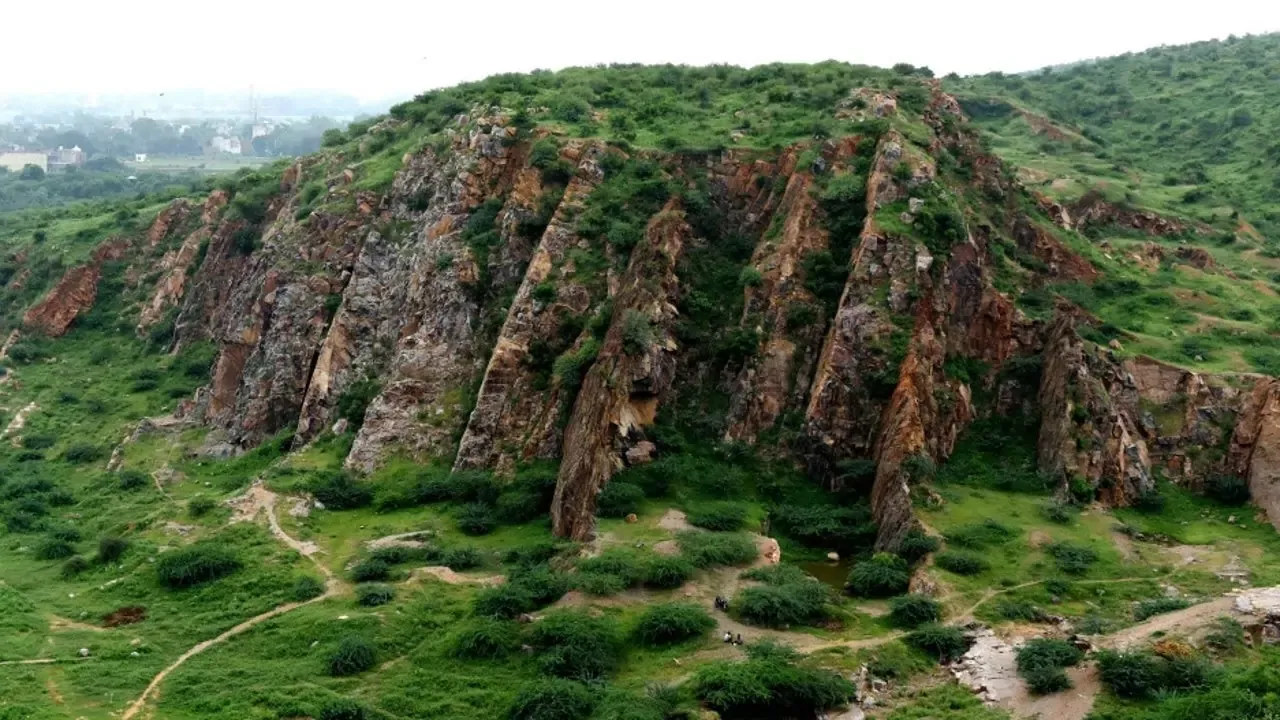
Beyond their geological value, the Aravalli Hills serve as a critical ecological shield for North India. One of their most important functions is slowing the eastward spread of the Thar Desert. By influencing wind patterns and acting as a physical barrier, the hills reduce the movement of sand and dust into the fertile Indo-Gangetic plains, helping to preserve agricultural productivity.
The Aravallis also play a key role in groundwater recharge. Their rocky terrain allows rainwater to percolate into aquifers, sustaining water availability in otherwise dry and semi-arid regions. Additionally, the hills contribute to moderating local climate conditions by influencing rainfall distribution and reducing extreme temperature variations in surrounding areas.
Wildlife Landscapes Linked to the Aravallis
Several important protected and semi-protected wildlife landscapes are embedded within the Aravalli system. These include Mount Abu Wildlife Sanctuary, which supports rich biodiversity, and the Aravalli Biodiversity Parks in Gurugram and Delhi-NCR that demonstrate ecological restoration of degraded land. Other forested stretches within the range support species such as leopards, hyenas, wolves, and bears.
The Aravallis also function as wildlife corridors, allowing animals to move between fragmented habitats. This connectivity is increasingly vital as cities expand and natural forests shrink. In urban and peri-urban areas, the range represents one of the last remaining natural buffers where wildlife and human settlements coexist under delicate ecological balance.
Why the Issue Goes Beyond Conservation
The debate surrounding the Aravalli Hills extends far beyond environmental conservation. It intersects with urban planning, air quality management, water security, and climate adaptation strategies in one of India's fastest-growing regions. Experts warn that weakening protection for low-altitude ridges could intensify dust storms, accelerate desertification, and place additional strain on already depleted groundwater reserves.
As policymakers and planners revisit how the Aravallis are defined and managed, scientists emphasize the importance of adopting an ecosystem-based approach. Viewing the range as a continuous geological and ecological entity, rather than a collection of isolated hills measured solely by height, is seen as essential for safeguarding North India's environmental stability in an era of escalating climate risks.
Facebook Comments







-
 Explore the upcoming Tamil film Maaman - cast, sto...
 -
 Read the ACE (2025) movie review starring Vijay Se...
 -
 Check out Maaman's 1st day box office collection a...
 -
 Explore tourist family reviews for Maaman movie –...
Popular Posts
Vote / Poll
Recent Posts




Recommended Posts

-
 Discover the best schools in Nagercoil f...
 -
 Discover the top-rated preschools in Nag...
 -
 Explore the best schools in Nagercoil th...

Comment / Reply From