Sensex tanks 800 points, Nifty slips under 25,900 as markets turn cautious ahead of Fed meeting
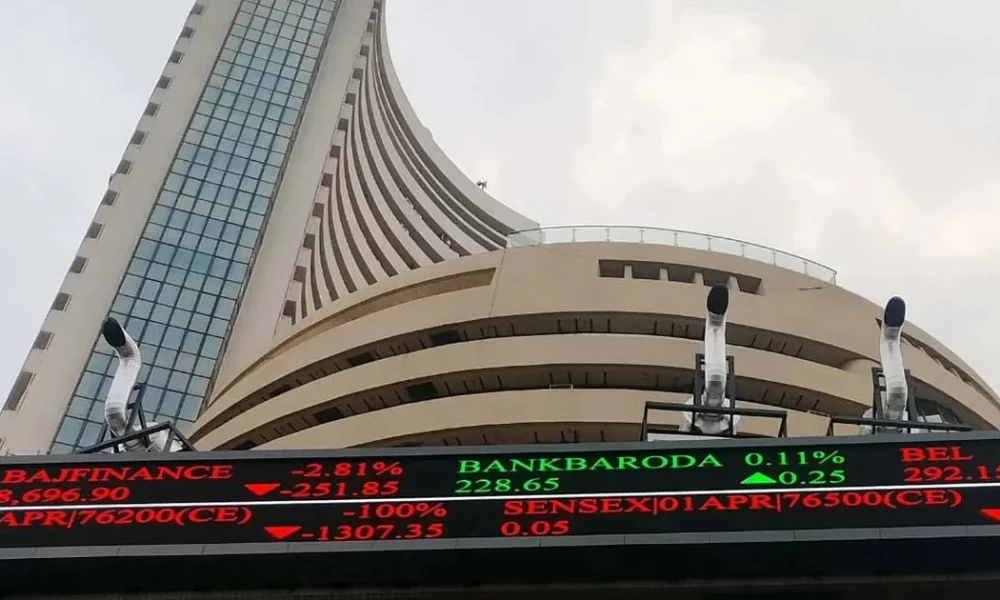
Sensex tanks 800 points, Nifty slips under 25,900 as markets turn cautious ahead of Fed meeting
Domestic equity markets came under notable pressure on Monday as investors chose to lock in profits after a strong recent run. The focus shifted firmly to risk management, with traders turning cautious ahead of the upcoming United States Federal Reserve policy decision. The session was marked by a broad-based decline, led primarily by mid-cap and small-cap counters, while benchmark indices also slipped close to one percent during intraday trade. Global uncertainty, sustained foreign institutional investor outflows and weakness in the rupee weighed collectively on overall sentiment.
Around 2:20 p.m., the benchmark Sensex index was down 802.71 points, or 0.94 percent, at 84,909.66, reflecting the risk-off mood among market participants. The broader Nifty index slipped 289.55 points, or 1.11 percent, to trade at 25,896.90, falling below the psychologically important 25,900 mark. The tone of the session remained weak, with sellers dominating in many pockets of the market that had earlier benefited from a strong multi-week rally.
In the Nifty50 basket, several stocks witnessed steep declines as traders exited high-beta counters and cyclical plays. InterGlobe Aviation, Bharat Electronics and JSW Steel were among the key laggards, slipping as much as 7 percent intraday as investors booked profits in names that had seen substantial gains in previous sessions. On the other hand, a few defensively positioned or relatively resilient counters such as HDFC Life Insurance Company and Tech Mahindra managed to stay in the green, rising up to about 1 percent and providing some limited support to the index.
Market breadth remained clearly negative throughout the session. The number of stocks declining on the broader exchanges far outpaced those advancing, indicating that the correction was not confined to a few sectors or themes. With more losers than gainers and only a small portion of the market managing to hold on to earlier levels, traders viewed the move as a healthy but sharp bout of profit-booking following an extended period of optimism in domestic equities.
Market overview: intraday performance and breadth
The intraday picture for both Sensex and Nifty reflected a persistent downward bias rather than a quick, one-off spike in volatility. Selling pressure was visible from the opening trades and intensified as the day progressed, especially in mid-cap and small-cap segments. Large-cap heavyweights also faced selling at higher levels, indicating that institutional and short-term traders alike were using any minor bounce to reduce exposure in a cautious environment.
The divergence between select defensives and the broader market was also notable. While a handful of stocks in sectors such as insurance and information technology managed modest gains, they were not strong enough to offset the wider decline across cyclicals, financials, industrials and broader market themes. Overall, the session underlined a shift in tone from aggressive risk-taking to capital preservation ahead of key global macro events.
Fed meeting jitters and global macro concerns
One of the central triggers behind Monday's weakness was the nervousness ahead of the United States Federal Reserve's upcoming policy announcement. The Federal Open Market Committee is commencing a two-day meeting, and traders across global markets are keenly watching for clarity on the timing and pace of any future interest rate cuts. Even if the headline policy rate remains unchanged, the tone of the commentary and the updated economic projections are likely to drive risk sentiment in the near term.
Market participants in India are particularly sensitive to any hint that rates in the world's largest economy may stay higher for longer than previously expected. A relatively hawkish outlook from the Fed could keep global bond yields elevated, reduce appetite for risk assets such as equities and potentially lead to further foreign portfolio outflows from emerging markets. Traders, therefore, preferred to cut positions and stay light ahead of the mid-week policy outcome rather than be caught on the wrong side of a volatile reaction.
Alongside the Fed, central banks in other major economies such as Australia, Brazil, Canada and Switzerland are also scheduled to review their monetary policies. While no major rate changes are widely expected from these institutions, their guidance on growth, inflation and liquidity can still influence global capital flows. Combined with upcoming inflation data and year-end portfolio rebalancing by large funds, this cluster of events has prompted traders to adopt a more defensive stance in the very short term.
Sell-off in mid-cap and small-cap segments
The most intense pressure during the session was visible in the mid-cap and small-cap spaces, where valuations had risen sharply in recent months on the back of strong domestic inflows and thematic buying. The Nifty Smallcap100 index declined more than 2 percent intraday, marking its fifth straight session of losses and taking its cumulative fall over the last five sessions to more than 4 percent. The Nifty Midcap100 index also slipped around 2 percent as investors cut back on relatively high-risk positions.
Analysts pointed out that the correction in this segment appears more like a positioning reset than a fundamental shift in the long-term outlook for India's growth story. Many mid- and small-cap stocks had rallied steeply, partly driven by abundant liquidity, leverage in trading accounts and crowding into popular sectors such as defence electronics, renewables and niche industrial names. When global macro concerns resurfaced and volatility ticked higher, these pockets naturally became the first candidates for profit-taking and de-risking.
The resulting price action was swift and, in some cases, brutal, with individual counters falling up to 7 percent. Such moves tend to get amplified when leveraged traders unwind positions and stop-loss levels are triggered in quick succession. While the broader trend in domestic equities over the medium term remains constructive, the recent rally in several mid-cap and small-cap counters had left them more vulnerable to even modest shifts in sentiment or liquidity conditions.
Persistent FII selling and global risk appetite
Another key factor weighing on sentiment has been the continued selling by foreign institutional investors. On Friday, FIIs were net sellers to the tune of about ₹438.90 crore, extending their selling streak for the seventh consecutive session. Although domestic institutional and retail flows have helped cushion the impact to some extent, persistent foreign outflows send a cautious signal to market participants who track global risk appetite closely.
The combination of elevated global interest rates, changing expectations around the timing of rate cuts and occasional bouts of risk aversion have made foreign investors more selective toward emerging market exposure. In this backdrop, even a strong domestic macro story like India's can see intermittent phases of profit-taking as global funds rebalance portfolios across regions and asset classes. Monday's moves in benchmark indices and the broader market must therefore be viewed in conjunction with this wider global repositioning trend.
Weakening rupee adds to market discomfort
Currency movements also played a role in the cautious mood. The rupee weakened by 16 paise to trade near 90.11 against the United States dollar in early trade. The local currency opened at 90.07 and gradually lost ground as the session progressed, pressured by stronger dollar demand from corporates, importers and overseas portfolio investors. The backdrop of higher crude oil prices and foreign outflows further contributed to the rupee's softness.
A weaker rupee can have a mixed impact on the equity market. While exporters and select information technology names may benefit from improved competitiveness and better realisation in rupee terms, the broader market often interprets currency depreciation as a sign of external sector stress and potential imported inflation. For an economy that relies significantly on imported crude oil, a weaker currency alongside higher oil prices can put additional pressure on the current account and inflation outlook, prompting investors to reassess risk positioning.
Higher crude prices and inflation worries
Brent crude, the global benchmark for oil, edged up to around 63.83 dollars per barrel. Even a modest rise in crude prices is closely watched in India, given the impact it can have on the country's import bill and overall inflation trajectory. Higher energy costs filter through to transportation, manufacturing and core inflation components over time, which can influence both monetary policy and household purchasing power.
In the current context, where central banks worldwide are balancing growth concerns with the need to keep inflation expectations anchored, any sustained move higher in crude prices adds another layer of uncertainty for equity investors. The combination of a slightly firmer crude price, a weaker rupee and global policy uncertainty created a backdrop in which traders were inclined to err on the side of caution rather than chase further near-term upside in risk assets.
Rising India VIX reflects growing caution
The India VIX, often referred to as the market's fear gauge, edged higher by about 2.11 percent to 10.53. While this absolute level still suggests that volatility is not excessively high by historical standards, the direction of movement is important. An uptick in the volatility index indicates that traders expect wider price swings in the near term, which typically leads to more conservative positioning and greater use of hedging strategies in derivatives.
For short-term traders, a rising VIX often encourages tighter risk controls, reduced leverage and selective participation in intraday trades. For longer-term investors, it can be a reminder that near-term noise may increase, even if the structural story remains unchanged. In Monday's session, the higher VIX figure aligned with the broader narrative of de-risking ahead of major global central bank events and key macro data releases.
Technical view on Nifty: key support and resistance zones
From a technical analysis standpoint, the Nifty had recently regained upside momentum after moving above its near-term resistance at the 26,100 mark on Friday. That breakout had suggested renewed strength in the index; however, the subsequent session's decline has brought attention back to crucial support zones. Analysts now highlight the 25,950 to 26,000 band as an important area to watch on the downside. As long as this region holds, the broader bullish structure on the index may remain intact, even if short-term volatility stays elevated.
On the upside, immediate resistance is seen near the 26,300 level, followed by a higher hurdle around 26,500. A convincing move above these resistance zones, supported by strong breadth and renewed buying interest in large-cap names, would be needed to signal that the current phase of consolidation and profit-booking is winding down. Until there is more clarity from the Federal Reserve and other global macro triggers, traders are likely to keep a close eye on these technical levels while managing risk closely in both index and stock-specific positions.
Facebook Comments














-
 Explore the upcoming Tamil film Maaman - cast, sto...
 -
 Read the ACE (2025) movie review starring Vijay Se...
 -
 Check out Maaman's 1st day box office collection a...
 -
 Explore tourist family reviews for Maaman movie –...
Popular Posts
Vote / Poll
Recent Posts




Recommended Posts

-
 Discover the best schools in Nagercoil f...
 -
 Discover the top-rated preschools in Nag...
 -
 Explore the best schools in Nagercoil th...

Comment / Reply From